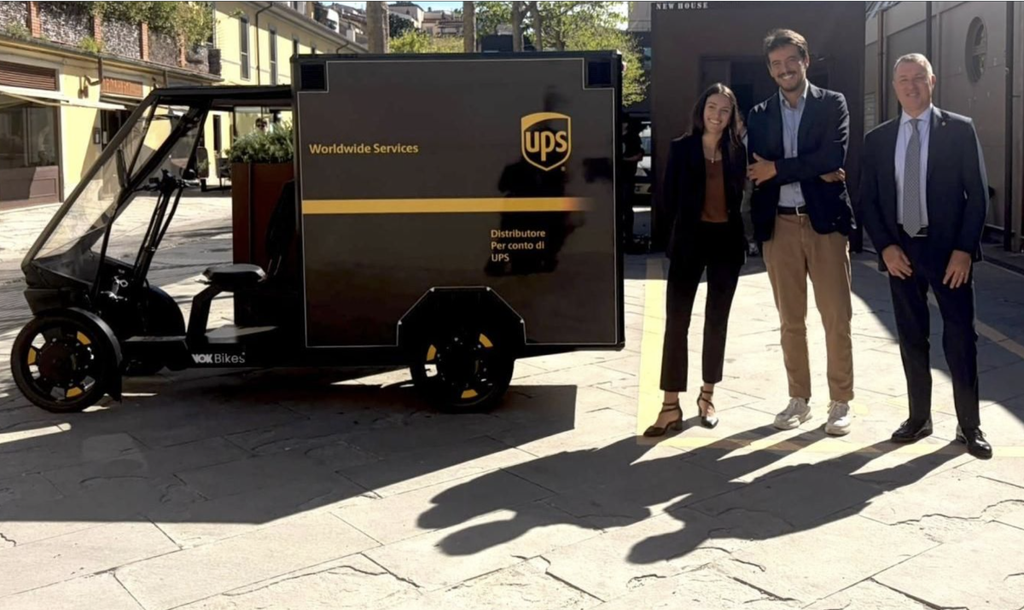
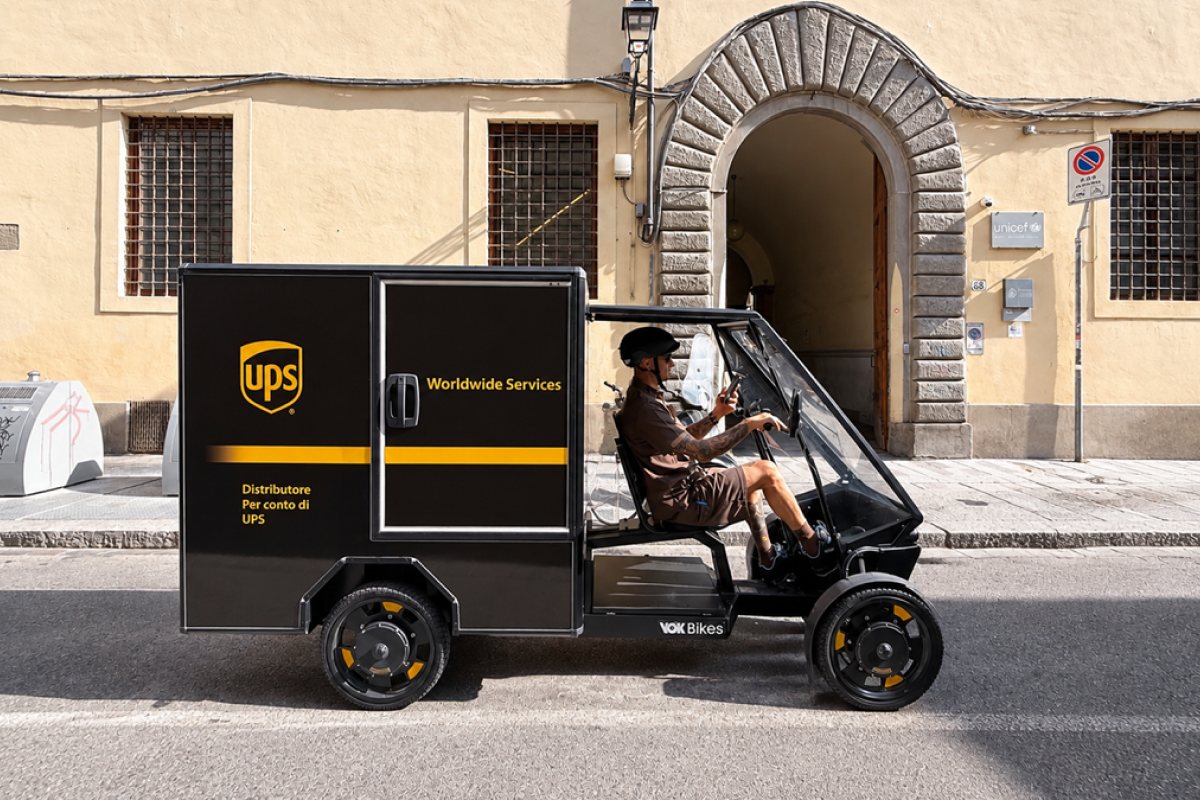
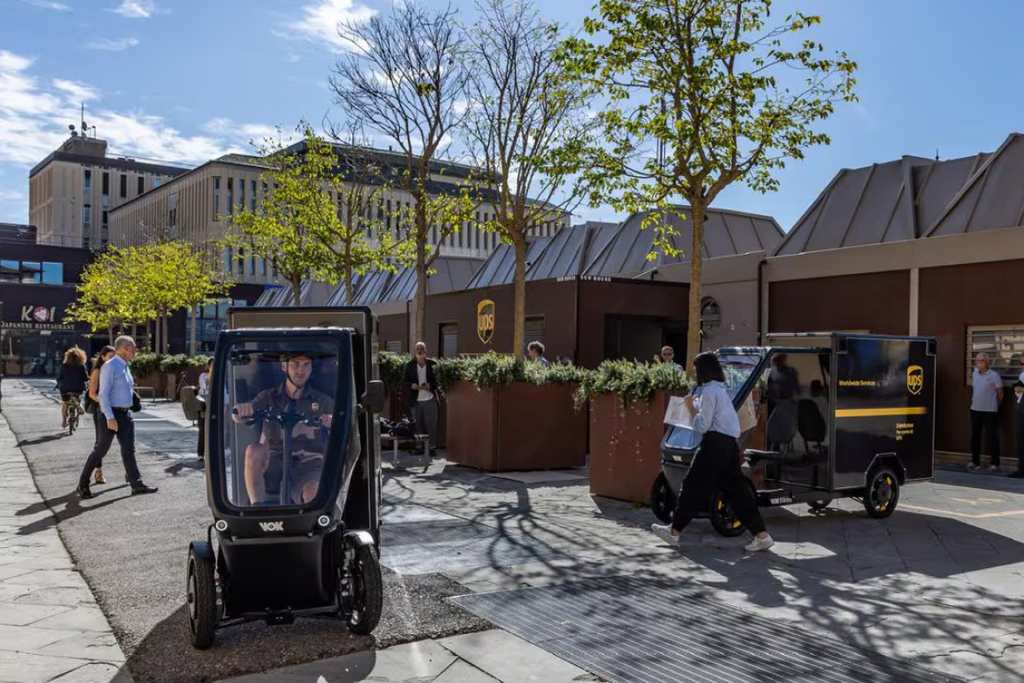
UPS, a global leader in logistics, is continuing its cargo bike expansion with Vok cargo bikes to make deliveries in Florence’s historic centre from a micro-hub in Piazza Annigoni, in the Sant’Ambrogio area.
Together with the City of Florence, UPS has launched the final operational phase of ‘Unchain’ – European project funded under the Horizon Europe programme to develop more efficient urban logistics. The acronym stands for «Urban Logistics and Planning: Anticipating Urban Freight Generation and Demand, Including the Digitalisation of Urban Freight».
Merit Veide, Head of Partnerships at Vok Bikes, said:
«We’re proud to supply the cargo bikes for UPS’s micro-hub in Florence. This is exactly the kind of urban logistics model we are seeing more and more across Europe: combining micro-hubs with purpose-built cargo bikes to make last-mile deliveries more efficient. Milan, Bologna, Verona and now Florence show that Italy is moving in this direction, and we will definitely see more Italian cities follow.»
Over the next 6 months, UPS will validate how micro-consolidation and cargo bikes make last-mile distribution more efficient and reduce its environmental impact under real operating conditions. The model aims to reduce the need for large vehicles in the most congested parts of the city centre. It also aims to improve delivery flows and make better use of the space available for loading and unloading. Standard and pedal-assist cargo bikes produce no emissions, take up less space than larger delivery vehicles and can help reduce congestion.
A dedicated digital platform will support the booking of loading and unloading bays, check-in and check-out procedures, and the management of activities at the micro-hub. Sensors and cameras will also help monitor how the available space is used. The Vok cargo vehicles will be assessed against indicators such as kilometres travelled, load levels and productivity.
Marzia Picciano, Public Affairs Manager at UPS, said: «The challenge of urban logistics calls for solutions developed through dialogue and collaboration between logistics operators, local authorities and all the stakeholders involved, making ever smarter use of data and technology. This project shows that there is no single solution for urban logistics. Innovation and pilot schemes developed with local institutions can help find more effective models for each specific context. We thank the City of Florence for believing in this initiative and for supporting a constructive dialogue and effective collaboration with UPS.»
Italian cities are under growing traffic pressure. The INRIX 2025 Global Traffic Scorecard ranks Rome 17th and Milan 24th among the world’s most congested cities, with drivers losing 76 and 67 hours a year in traffic. At the same time, public institutions are pushing for change. Under the EU’s revised TEN-T regulation, 424 major European cities, including Florence, Milan, Rome, and Bologna must adopt sustainable urban mobility plans that cover freight as well as passengers by 2027. Pilots such as UNCHAIN in Florence show local government and market-leading logistics operators working towards the same goal: cleaner, more efficient city deliveries. The result is quieter, safer and cleaner environment for residents, businesses and visitors alike.
Andrea Giorgio, Florence’s councillor for Mobility and Traffic, Tramway, Ecological Transition, Urban Safety and Municipal Police, added: «The UNCHAIN project goes exactly where we want to go: changing our approach to urban logistics. Since Covid, this issue has become even more important, with deliveries in the city up by 300%. Trialling cargo bikes from the Piazza Annigoni micro-hub lets us assess a sustainable alternative in the field. It can reduce the impact of large vehicles in the historic centre and cut down on how often they share space with pedestrians and cyclists. It is one piece of the wider work we are doing with the Chamber of Commerce to develop the Urban Logistics Plan. We thank UPS for choosing Florence as the testing ground for a model that looks to the future of our cities.»