

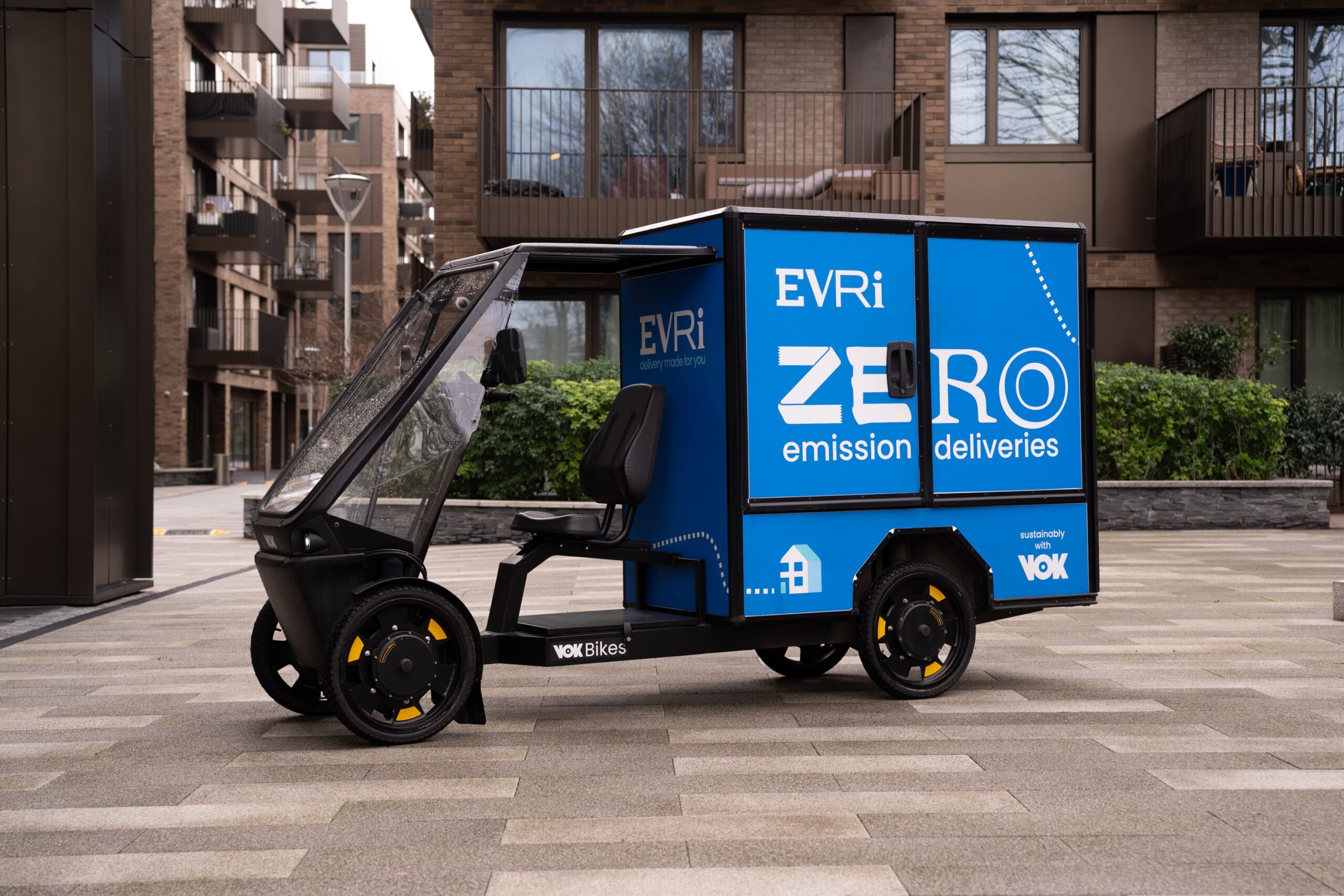
Evri is one of the UK’s largest parcel delivery companies, handling more than 900 million parcels annually. With a strong commitment to sustainability, its urban delivery choices shape how freight moves in British cities and influence operational standards across the logistics industry.
“Evri is spearheading cargo bike deployment in the UK and playing a leading role in scaling their use in urban delivery. We’re delighted to be joining them on that journey as cargo bikes become an increasingly important part of last-mile logistics,”
says Chris Cayford from Vok Bikes, who played a key role in supporting the project.
But what is driving Evri to rethink its urban fleet? Can cargo bikes truly handle heavy-duty commercial use? And what measurable impact did Vok Bikes deliver during the trial? Read on to find out. 👇
Testing under real pressure – are cargo bikes truly reliable?
When parcel networks trial final-mile delivery vehicles, it’s usually in controlled conditions: quieter months, shorter routes, and plenty of operational slack.
Evri took a different approach.
Between November 2025 and January 2026 – its busiest period of the year – Evri deployed a Vok cargo bike on some of its most demanding urban routes, operating them continuously through winter conditions.
This wasn’t a theoretical test. It was a stress test: high parcel volumes, poor weather, and zero tolerance for downtime.
The result? A clear success.
Measurable impact 1: zero servicing, full uptime
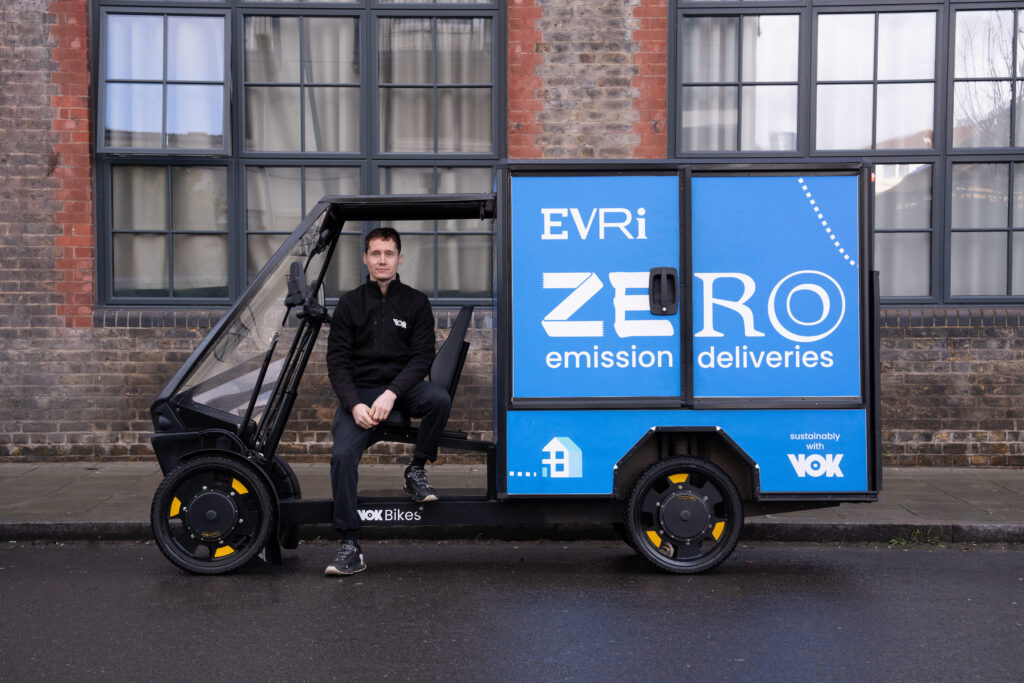
Across the entire trial, Vok cargo bikes required no servicing. Despite constant daily use, peak-season workloads, and winter exposure, the bikes achieved 100% uptime.
For a parcel operator, that’s critical.
Traditional cargo bike fleets – especially those based on bicycle-derived drivetrains – typically require frequent maintenance. Chains, gears, spokes, and other exposed components wear quickly in commercial use, often requiring weekly servicing and resulting in unexpected downtime.
Vok’s approach is fundamentally different. Its pedal-by-wire system with sealed electric components removes many of these failure points – no chains, no exposed gearing, no high-wear mechanical parts.
The result: vehicles that behaved more like fleet assets than bicycles, running continuously through peak season without intervention.
Measurable impact 2: efficiency increase by 15%
Over the three-month trial, approximately 14,000 parcels were delivered using Vok cargo bikes.
Based on route profiles, the fleet is estimated to have covered about 720 miles, with an average of about 10 miles per vehicle per day. Beyond volume, the trial delivered a clear operational gain:
+15% increase in drops per hour compared to Evri’s traditional courier fleet.
This improvement came from Vok’s two key advantages:
- Faster movement through cities via bike lanes and bus lanes
- Increased property access, reducing time spent parking and walking to delivery points
Together, these translated into faster, more efficient last-mile delivery in dense urban environments.
Rethinking the role of vans in urban delivery
Evri’s interest in cargo bikes is not new. The company is widely regarded as the UK’s most active parcel operator in cargo bike deployment, with over 113 bikes currently operated in London, and has indicated eCargo expansion of 3,000 units over the decade.
But this trial reflects a broader shift in how urban delivery fleets are being structured.
Vans – electric or otherwise – remain essential but are increasingly expensive to operate in dense urban areas, with efficiency sharply declining due to congestion, parking constraints, and access restrictions.
Cargo bikes are increasingly filling the gap that vans struggle with in city centres.
“While vans remain the final-mile vehicle of choice, cargo-bikes are playing an increasingly crucial part in urban logistics routes, supporting dense city operations where traffic and driving restrictions decrease efficiency. In addition, cargo bikes provide social benefit by opening courier work to younger demographics who aren’t learning to drive or don’t have vehicle access,”
adds Luke Turnbull, eCargo Operations Manager at Evri.
Beyond operational efficiency, this shift has wider implications for workforce accessibility and the future of urban logistics.
A clear signal of where last-mile delivery is heading
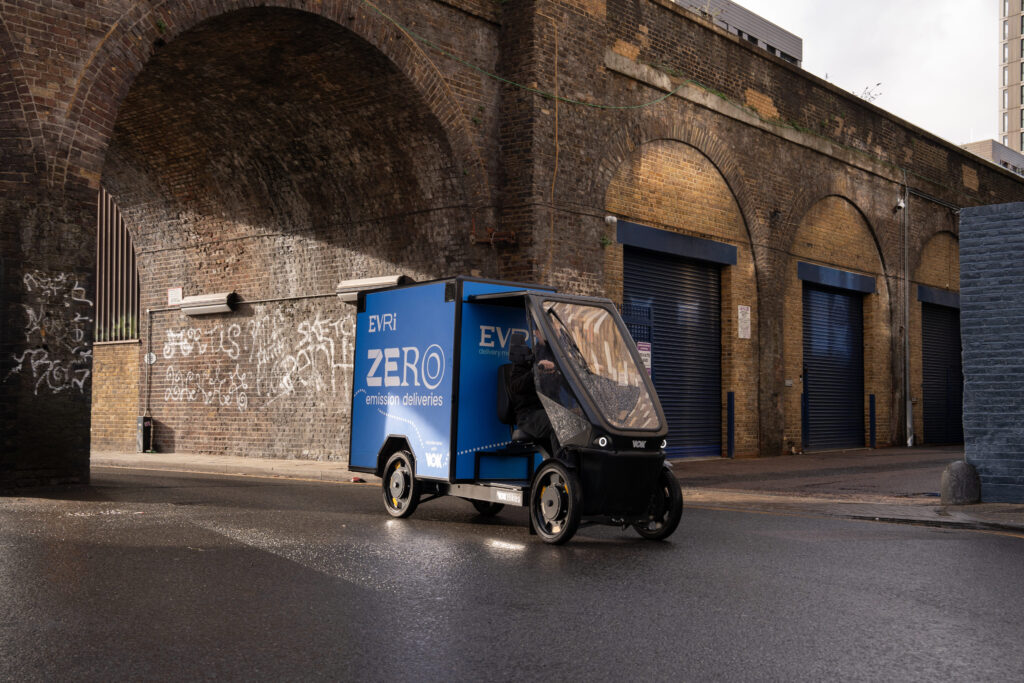
Cargo bikes are no longer being evaluated as experimental or environmentally symbolic solutions. They are being judged on the same criteria as any other delivery vehicle: uptime, cost, reliability, and performance under pressure.
Running a new vehicle through peak season, on the most demanding routes, without requiring servicing, and achieving full availability, is not typical of cargo bike trials.
But it is exactly what large logistics operators need to see before treating cargo bikes as core infrastructure.
As congestion worsens and the economics of van-based delivery continue to erode, trials like this suggest that cargo bikes are moving decisively from the margins of last-mile logistics toward the centre.
For Evri, the conclusion is clear:
“Vok cargo bikes present great value for parcel operators. The trial showed that Vok provides a comparable offering to the traditional van in terms of reliability and payload, and outperforms it on productivity metrics. While vans remain better suited for higher mileage, there are clear operational, environmental, social, and cost benefits to utilising eCargo on dense ultra-urban routes. We look forward to introducing Vok eCargo bikes to our growing fleet in the coming months.”


